About Product
One pass through four engines. Safety out one side, revenue out the other.
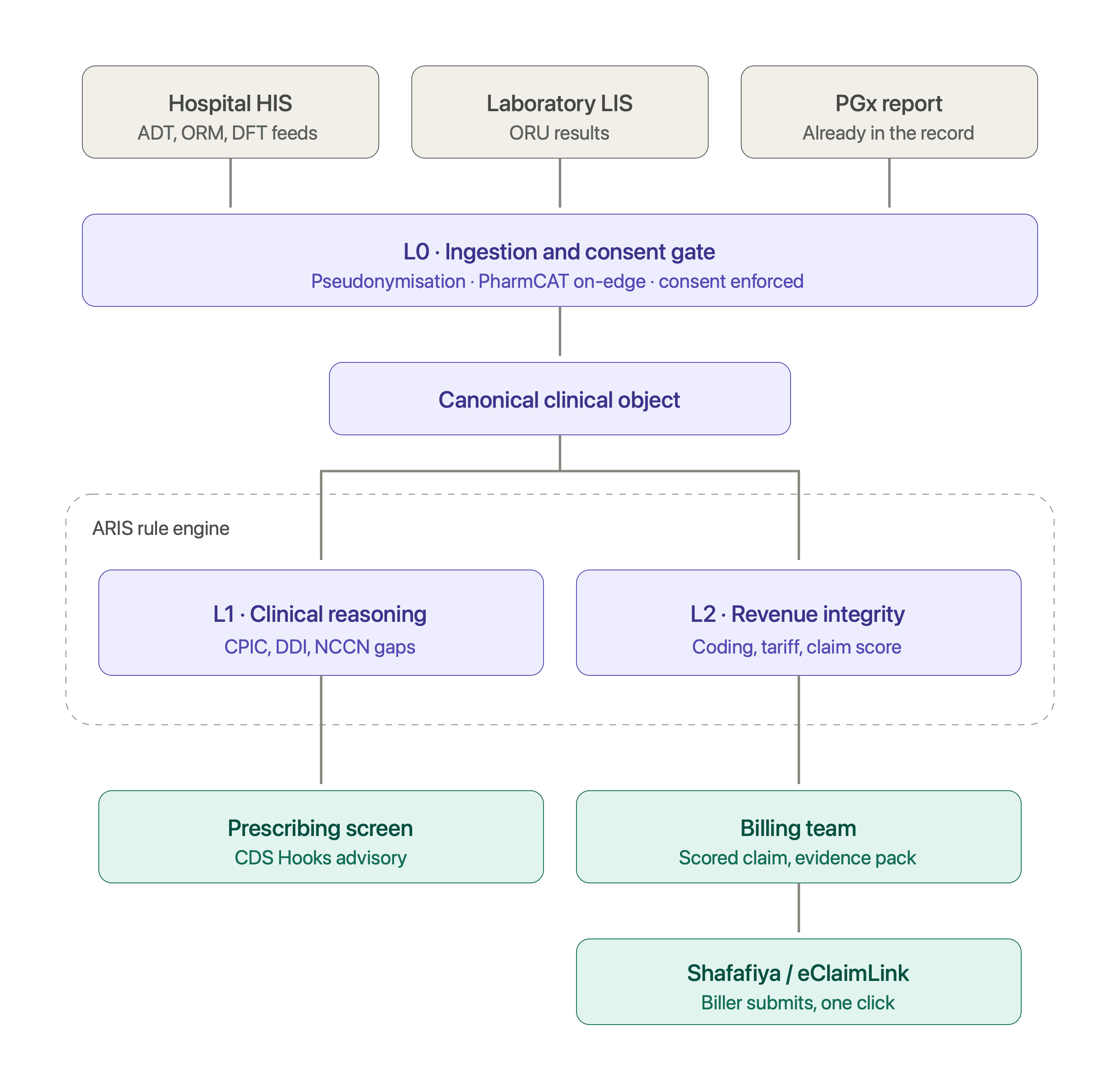
AGenomics is a layered architecture. Data enters once through the L0 ingestion gate, is reasoned over clinically in L1, converted into revenue integrity in L2, and governed throughout by the ARIS rule engine and its versioned rule store. Everything runs with UAE data residency and PDPL compliance built into the architecture rather than bolted on.
The final product deploys as an edge container inside the hospital's own data centre (on-premise); for the POC and 90-day pilot only, the stack runs on a UAE-specific cloud instance (Microsoft Azure UAE North) to keep all data in-country during the trial.
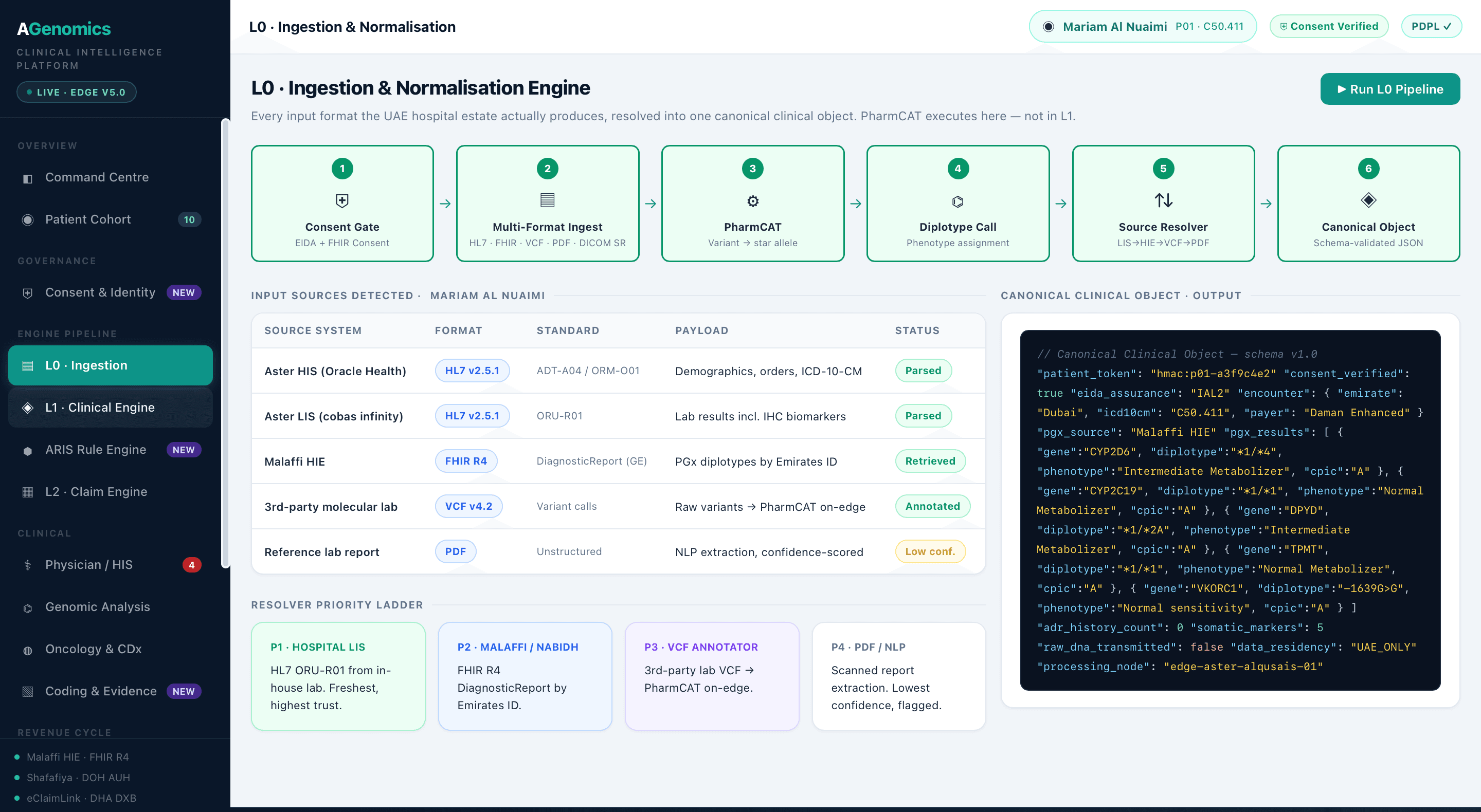
Ingestion Gate & Data Normalisation Engine
Every message in — validated, consented, normalised.
L0 is the front door. It accepts the HL7 v2.x and FHIR R4 traffic your HIS already emits, validates each message, resolves patient identity against Emirates ID, checks consent status, and normalises everything into a single canonical clinical record before any reasoning happens.
Nothing proceeds without a clean, consented, correctly-identified payload — which is how residency and PDPL compliance start at ingestion, not as an afterthought.
- HL7 v2.x
- FHIR R4
- Emirates ID resolution
- Consent gate
- Canonical record
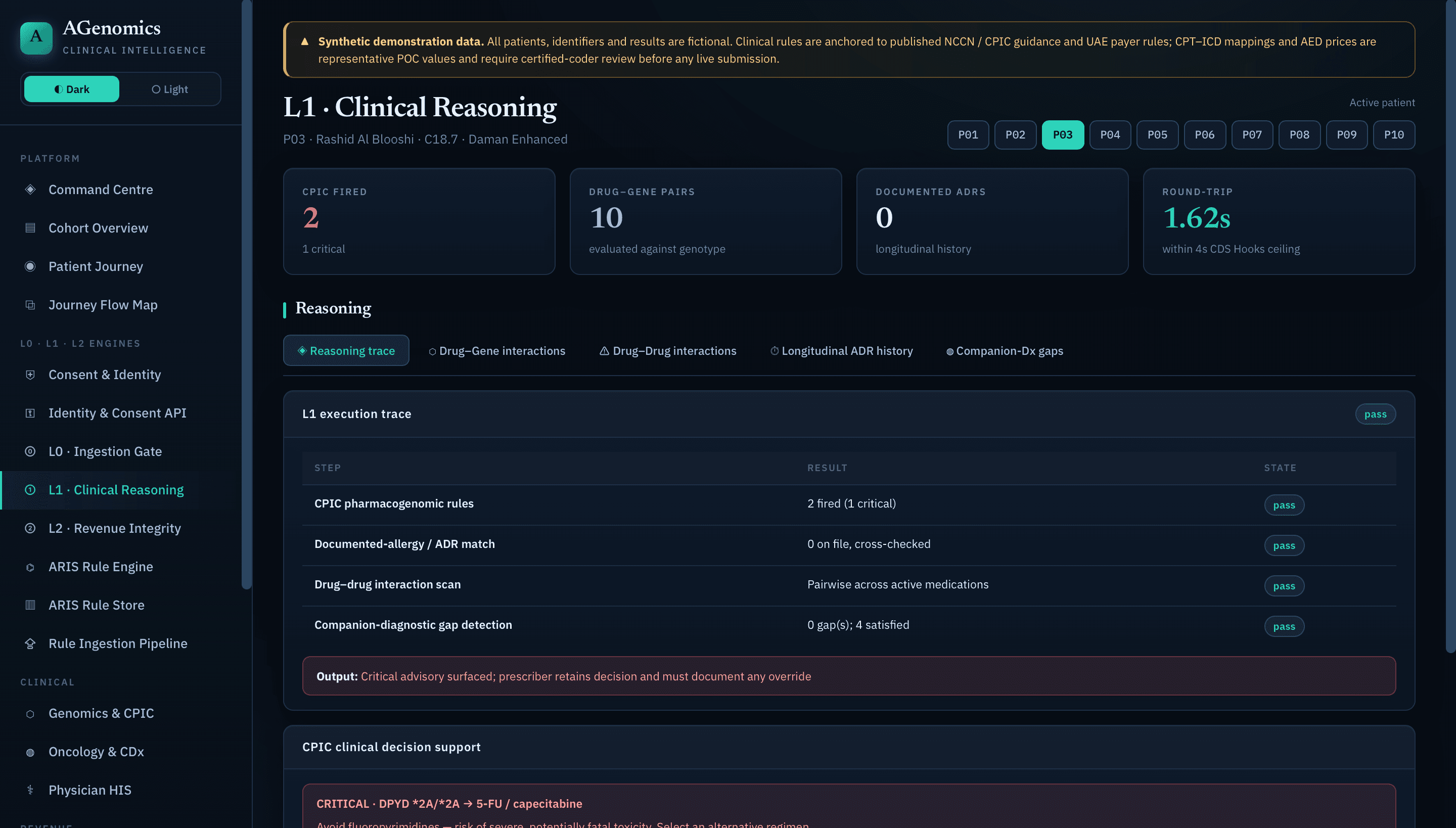
Clinical Reasoning Engine
Genomic evidence becomes a graded clinical decision.
L1 is where the clinical intelligence lives. It maps the patient's pharmacogenomic (PGx) profile against the medication being prescribed, applies CPIC and PharmCAT logic, and produces a severity-graded recommendation — critical alert, dosing note, or clear — delivered back through CDS Hooks into the physician's prescribing screen in real time.
Where genomic data arrived as a raw VCF lab file, the annotator resolves it to the same output in under three seconds. This engine is the source of the alert clinicians see and the genomic justification billers later attach.
- CPIC
- PharmCAT
- DDI matrix
- CDS Hooks
- VCF annotator < 3s
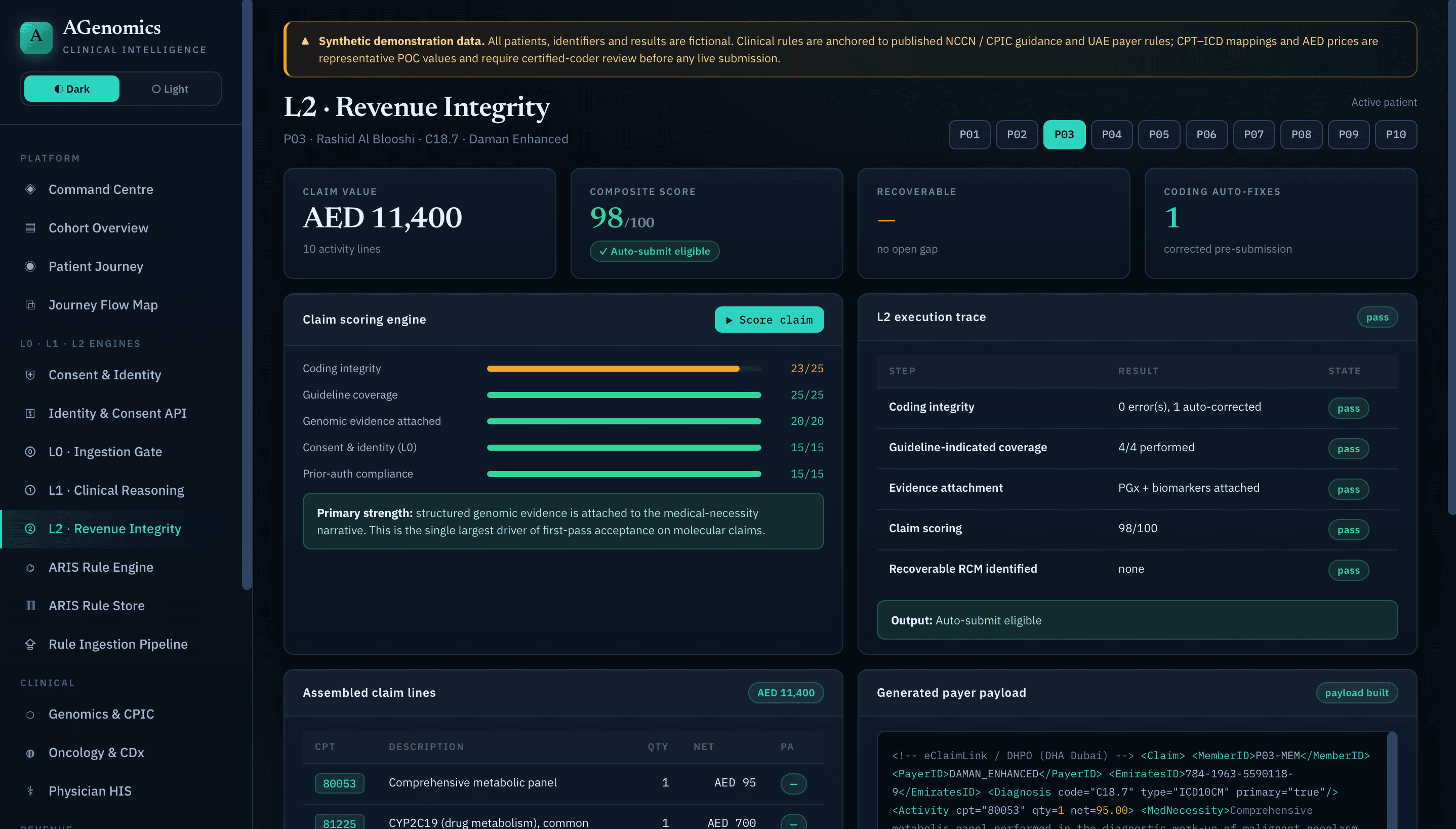
Financial Revenue Engine
The same evidence, scored for the payer.
L2 turns clinical truth into financial integrity. Using the identical evidence L1 produced, it scores each claim 0-to-100 against live UAE health-insurer rules across eligibility, coding accuracy, medical necessity, pre-authorisation linkage, genomic justification, and FWA risk.
Claims above threshold go to your biller for submission approval with one click; the rest queue with the exact missing element flagged and, often, a one-click fix that writes the medical-necessity narrative from genomic evidence. This is the engine your CFO, RCM director, and billing team watch.
- Eligibility
- Coding accuracy
- Medical necessity
- Pre-auth linkage
- Genomic justification
- FWA risk
Rule Engine & Rule Database
Every decision traceable to a versioned rule.
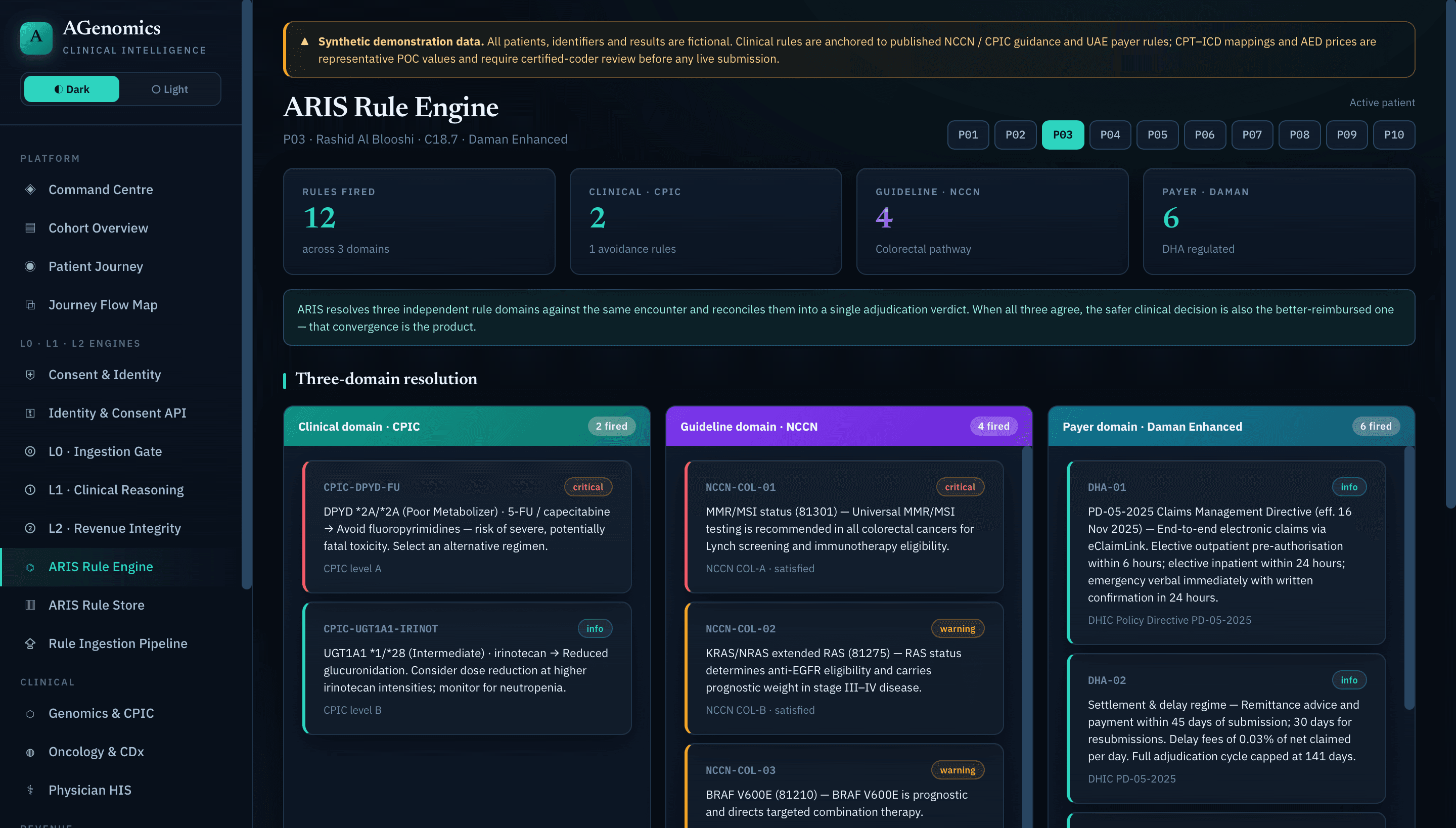
ARIS is the governance layer spanning L0–L2. It is the rule engine that decides how each message is validated, how each drug–gene pair is scored, and how each claim is judged — plus a versioned rule store where every rule is transparent, auditable, and attributable.
When a payer or regulator asks why a claim was scored the way it was, the answer is a specific, versioned rule, not a black box. This is what makes the platform defensible clinically, financially, and legally at once.
- Versioned rules
- Full audit trail
- Attributable decisions
- Spans L0–L2
Architecture trust
Where it runs is the compliance answer.
Final product edge-deployed inside the hospital firewall
Genomic data never leaves the UAE
PDPL-compliant by architecture
HL7 v2 · FHIR R4 · CDS Hooks native
POC & pilot run on a UAE cloud instance (Azure UAE North)